
office@qianqianjk.com
86-0532 82597899
In the equipment of a slide in camper, the electrical system is the core, which includes four major parts: power generation, power conversion, circuits, and batteries.
The battery is like the "heart" of a slide in camper, determining how far you can travel, how long you can stay, and how comfortable your life will be.
This article will explain the batteries in the slide in camper electrical system from common battery classifications, battery comparisons, how to choose the right battery, and how to use the battery scientifically, so you can understand it all at once.
Common battery classifications for slide in campers
Comparison between lead-acid batteries and lithium batteries for slide in campers
How to choose the right battery capacity for a slide in camper
How to use a slide in camper battery scientifically
Conclusion
Batteries are the important power source for all electrical systems inside a slide in camper. These slide in camper batteries ensure that all equipment, from lights to appliances, runs seamlessly during your travels.
There are two types of batteries on the market: lead-acid batteries and lithium batteries.
A lead-acid battery is a storage battery whose electrodes are mainly made of lead and its oxides, and the electrolyte is a sulfuric acid solution.
In the discharge state of a lead-acid battery, the main component of the positive electrode is lead sulfate, and the negative electrode is also lead sulfate; in the charged state, the main components of the positive and negative electrodes are lead dioxide and lead, respectively.
Lead-acid batteries are relatively low in price, but have a shorter lifespan, limited depth of discharge, and are heavier.
A lithium battery is a type of battery that uses lithium metal or lithium alloy as the negative electrode material and a non-aqueous electrolyte solution.
Compared with lead-acid batteries, lithium batteries have obvious advantages in charge-discharge efficiency, storage capacity, volume, and weight.
Moreover, the depth of discharge (DOD) of lithium batteries can reach 80%-90%, far higher than the 50% of lead-acid batteries.
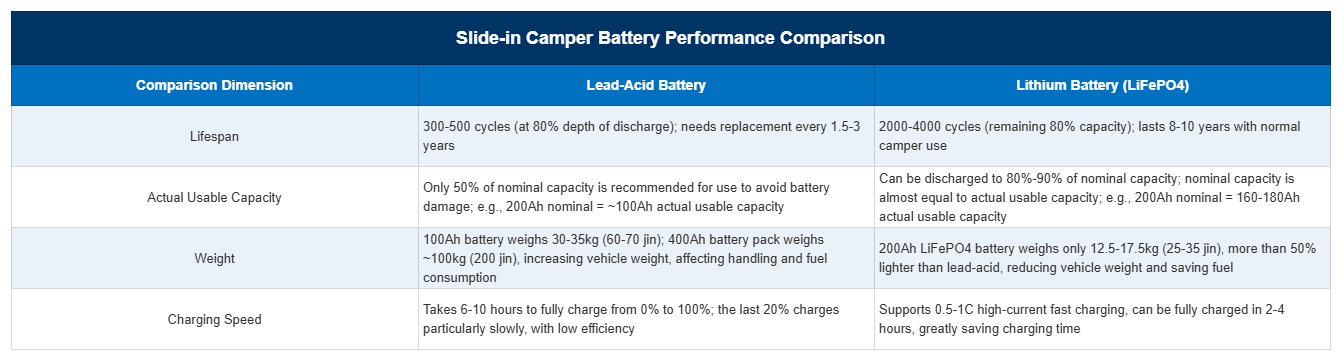
Based on my actual usage experience, lithium batteries are expensive, but the actual experience is very good.
My original slide in camper came with a 12-volt circuit and a 400Ah gel battery. The first year of use was fairly smooth, but after more than a year, problems like inability to charge and overly rapid discharge occurred. Especially during a trip to Florida this July, the battery completely failed, making the air conditioner and refrigerator unusable.

So I decided to replace it with lithium batteries. On November 20th, I replaced it with an 800Ah lithium battery. Previously, I didn't dare to use large appliances, but now I can use them with confidence and basically don't have to worry about insufficient power.
If the budget allows, it is recommended to directly choose lithium batteries. They have a long service life and large usable capacity, which is very cost-effective in the long run.
How to choose the right lithium battery
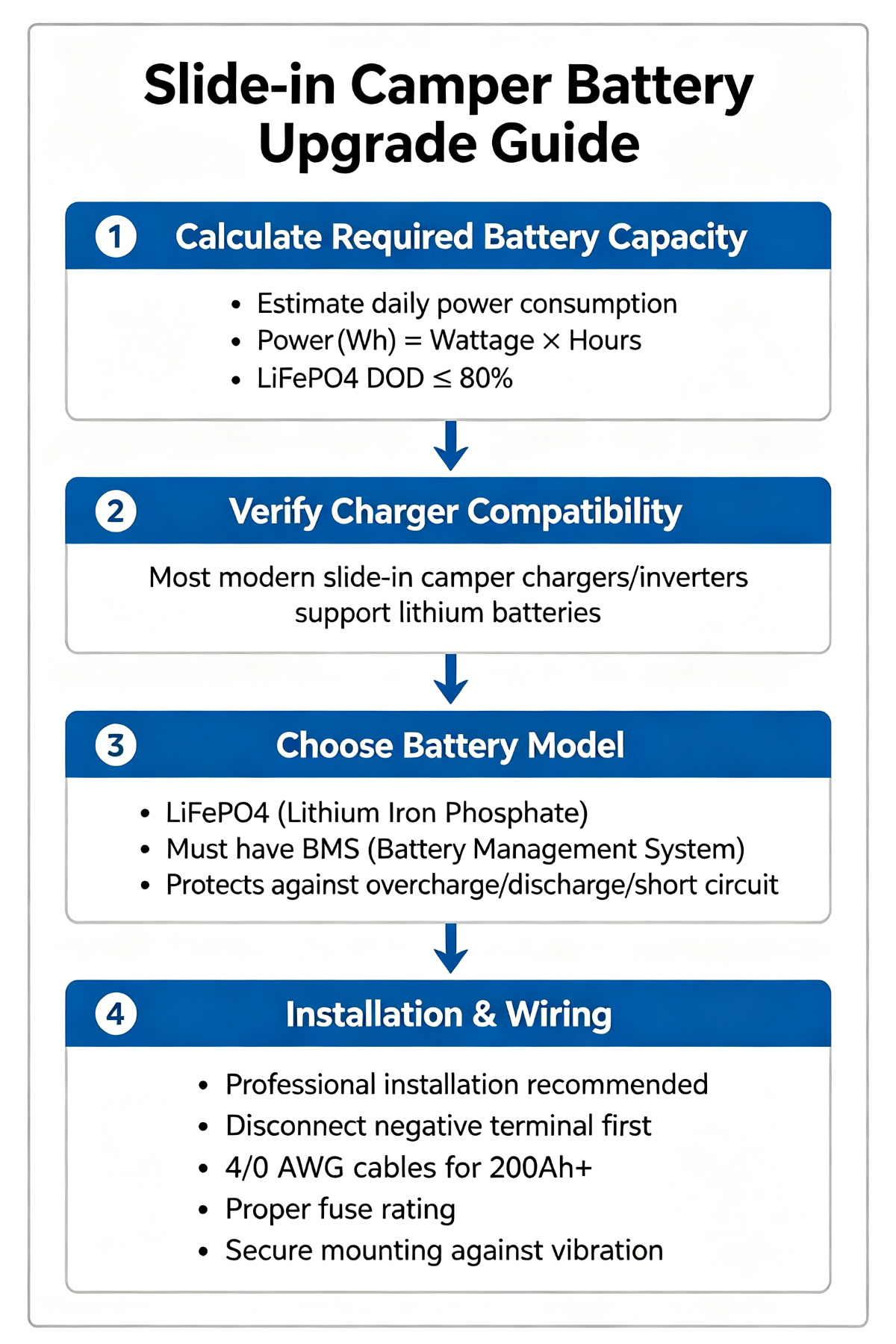
How to choose the right lithium battery? Based on my experience, I have summarized four steps to select the appropriate lithium battery.
Step 1: Accurately estimate daily power consumption
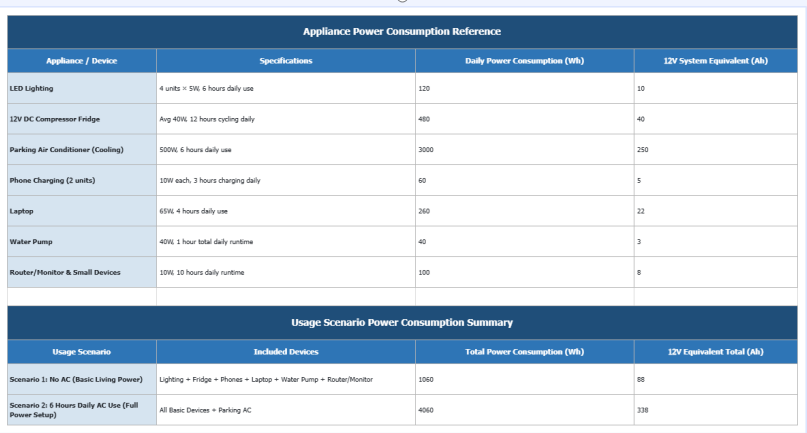
Calculate the capacity you need, estimate daily power consumption (based on actual appliance power). The most important step in RV power planning is to accurately estimate daily power consumption.
Calculation formula: Power consumption (Wh) = Appliance power (W) × Average daily usage time (h);
Convert to amp-hours (Ah): Required amp-hours (Ah) = Total power consumption (Wh) ÷ 12V (taking a 12V system as an example)
The figure below is based on typical data estimation for mainstream 12V RV appliances:
Step 2: Confirm whether the current charger is compatible
Most modern slide in camper chargers/inverters support lithium batteries. You can check the battery type support list in the charger manual, or ask the manufacturer to see if the charging parameters include a lithium battery mode.
Step 3: Select the battery model
The mainstream on the market is the lithium iron phosphate battery. When choosing, you must select one with a BMS (Battery Management System). This is very important, as it can prevent overcharge, over-discharge, short circuit, over-temperature, and other problems.
Step 4: Installation and wiring
To install a lithium iron phosphate battery pack, you need to prepare some tools, such as 25mm² or thicker copper wire, copper lugs, a crimping tool, a hammer, a wrench, corrugated tubing, insulating tape, nylon tape, a glue gun, silicone sealant, an electronic scale, etc. Among them, the copper wire should be flame-retardant, the type with the letter ZR in front of the model number; the copper lugs should be tin-plated copper lugs, and the corrugated tubing must be made of insulating material, not the type with steel reinforcement.
Installation steps
Battery parallel connection
First, connect the two batteries in parallel, positive to positive, negative to negative. The manufacturer's installation guidance said to use 25mm²copper wire, but you can also use the 50mm² copper wire that came with the inverter. When connecting the batteries, ensure the connections are firm to avoid poor contact.
Connect the coulomb meter
Connect the coulomb meter in series in the negative loop of charging and discharging, where the B- terminal connects to the battery negative, and the P- terminal connects to the charge/discharge load (including the large inverter negative and the chassis ground negative wire). The shunt comes with an insulating protection box, and the inverter does not go through a fuse.
Finishing work
The coulomb meter display can be installed under the refrigerator, under the rear small bed, or in another suitable location. Secure the wires with zip ties and install the cover plate. Also do some dust-proofing work: use a glue gun to apply a bit of silicone sealant to seal the holes under the large drawer and the holes for the connecting wire from the inverter to the battery. You can also use the eliminated original 16mm² copper wire to make a grounding wire for static electricity elimination.
During installation and wiring, pay attention to the following points:
1. Disconnect power first, remove the negative terminal before the positive terminal to avoid short circuits.
2. Use sufficiently thick wires. For lithium batteries above 200Ah, it is recommended to use 4/0 AWG (about 120mm²) cable (Cable cross-sectional area (mm²) = (Length (m) × Current (A) × 0.0164) / Allowed voltage drop (V)).
3. The fuse specification must match the current-carrying capacity of the circuit to prevent short-circuit hazards.
4. Secure firmly. Lithium batteries are most afraid of vibration; prevent loosening and damage during driving.
Slide in camper batteries need to be used scientifically in order to extend their lifespan and better serve our slide in camper travel and life.
Plan Your Route and Power Needs in Advance
You need to plan your itinerary, the parking time at each destination, and the daily power consumption. Rationally arrange driving time and parking time, avoiding long charging times and short discharging times, especially prolonged charging without use when the battery is fully charged.
Save electricity
No matter how large a slide in camper battery is, it is still finite, so planned power use and electricity saving are necessary, and they should become a habit.
First, based on the parking period, plan the total power of appliance use and the duration of use each day, and arrange electricity use reasonably. Our daily living electricity consumption follows a pattern; the power consumption is basically fixed. Considering some special circumstances, planned electricity use is easy to achieve.
Second, use low-power appliances, recommended to be around 500 watts, not exceeding 1000 watts at most. Preferably dual-voltage, 220V and 12V, or 220V and 48V, suitable for both vehicle and household use. The greatest advantage of low-power appliances is that multiple appliances can be used simultaneously, increasing overall efficiency, just as "many hands make light work."
Power on sequentially
The instantaneous voltage and current when powering on an appliance can impact the power supply system, especially the inverter and battery. Overload may cause damage. Therefore, power on sequentially, leaving a time interval between each appliance, or observe the coulomb meter until the voltage and current stabilize before powering on the next one.
Ventilation and heat dissipation
Slide in camper batteries generate heat during prolonged charging and discharging. Overheating of the battery can affect charging and discharging efficiency in mild cases, or cause damage or other accidents in severe cases. Therefore, be sure to provide good ventilation and heat dissipation.
Limited by space and environment, the house battery of a slide in camper is installed in an enclosed space, and ventilation and heat dissipation are generally not very good. We need to pay extra attention to this. For example, during a stopover or after parking, open the battery compartment door for ventilation and heat dissipation.
Especially in summer, pay extra attention to observing the battery status and promptly handle any abnormalities.
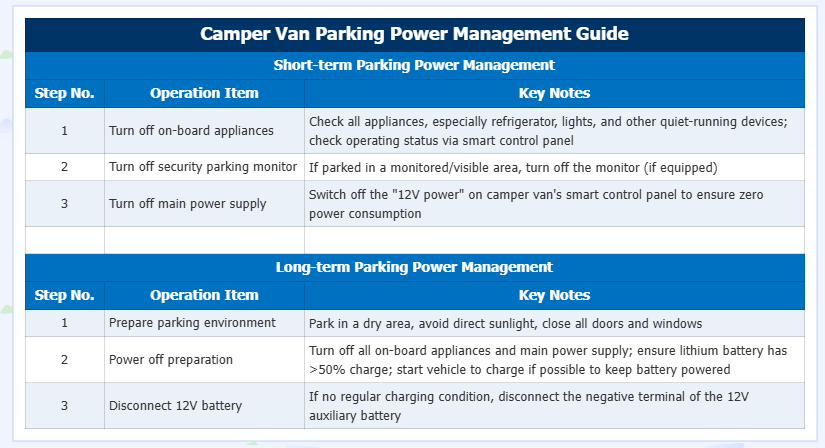
Maintenance during parking
You can choose the appropriate battery and circuit configuration based on your electricity usage habits, travel style, and budget. By using the battery scientifically, you can make your slide in camper life more comfortable. If you have other good methods, please leave a comment in the comment section.
Contact: Chris
Phone: 86-0532 82597899
E-mail: office@qianqianjk.com
Whatsapp:86-13455286111
Add: Shandong Province, Qingdao, 26 Xinyuan West Road
We chat